Tuesday, October 22, 2019

Garland Arthur Howell part 1

1914 Garland is born
1916 -- Sister Pauline Melissa is born
1918 -- Sister Letha Blanch is born

Garland Arthur Howell, 1914 - 1961


    1914

    Johnston County North Carolina
    from Random Acts of Genealogical Kindness

    Garland Arthur Howell's birth, 22 December, Johnston North Carolina.  He was the second child born out of 13 children total.  Mother Katie was age 20, father Fristus was age 42.


    Mini Pedigree from Ancestry.com

    Birth Index for Garland Arthur Howell's birth
    from General Index to Births in Johnston County NC
    "B.H." is for Boon's Hill


    1916, age 1

    Sister Pauline Melissa was born, 4 October, Johnston NC.  She was the third child born, and is listed as Malissa, and she died in 1993.

    1918, age 3

    Sister Letha Blanch Howell was born in Princeton NC.  She was the fourth child born, and she died in 2000.  At first glance it looks as if the family moved, but when we look closer, Princeton is in Johnston County NC.  The family did, however, move from Boone Hill where Garland was born to Princeton where Blanch was born.


    If you like what you see, be sure to subscribe, and consider supporting me on my patreon page


    Become a Patron!


    Resources


    Monday, March 19, 2018

    I did a research on the Johnston county historical website, link below.  Here are three or four things I have found.


    Name:Howell, Jethro H.
    Rank / Company:Pvt. / D
    NC Regiment:13th Battalion, NC Infantry, 

    http://www.johnstonnc.com/heritage2/hc_soldier_search.cfm

    -------------------------------------------------------------------------------

    This looks like it would be for Fristus H. Howell.  The age is about correct.  The place is certainly correct.  But I have absolutely no idea who Ancestor Joe Howell would be.  Does anybody have any ideas?
    http://erec.johnstonnc.com/recorder/eagleweb/customSearch.jsp?pageId=DeedRecords&searchId=0


    Record ID:2667
    Name:Howell, F.H.
    Age:26
    Ancestor:Joe Howell
    State:NC
    Date of Application:October 22, 1902
    Township:Boon Hill


    Same thing for this entry.  Again the dates are approximately correct, but again I don't know who this Jno is ... Jonathan?

    1902 Johnston County Voter Registration 

    Record ID:
    2689
    Name:Howell, J. Henry
    Age:50
    Ancestor:Jno. Howell
    State:NC
    Date of Application:October 7, 1902
    Township:Boon Hill

    http://www.johnstonnc.com/heritage2/hccontent.cfm?PID=voter


    If you like what you see, be sure to subscribe, and consider supporting me on my patreon page


    Become a Patron!


    Monday, February 26, 2018

    Arlie Virginia Howell 1913 - 1934


    • 1913 -- birth in October
    • 1914 -- brother Garland is born
    • 1916 -- sister Pauline Melissa is born
    • 1918 -- sister Blanch is born
    • 1920 -- sister Lois is born
    • 1920 -- residence Boon Hill, Johnston, North Carolina
    • 1920 -- Historical Insight, Sears, Roebuck and Company
    • 1920 -- Historical Insight, Nationalization of 4-H programs
    • 1921 -- brother Thad is born
    • 1924 -- brother Paul Coolidge is born and died
    • 1926 -- brother Roland is born
    • 1928 -- brother Haywood is born
    • 1930 -- residence New Hope, Wayne, North Carollina
    • 1931 -- sister Alline is born
    • 1933 -- sister Eula Evelyn is born
    • 1934 -- untimely death and burial


    She was on this earth for only 20 years.  She was the eldest of 13 children born to Fristus and Katie Howell.  Fristus was 41 years old and Katie was 18 when she was born.  I don't really have much information about her life, but what I have is here.

    Arlie Virginia Howell
    Mini Pedigree from Ancestry.com


    1913 -- birth in October, the first of 13 children


    I don't have a birth certificate for Arlie Virginia.  I suspect she was called by her middle name, since it seems that everyone else went by middle names.  I think they used the first name in formal instances, and the middle name was the more familial and informal name.
    According to North Carolina Vital Records, birth certificates are available in 1913.  I tried to access a birth certificate, but am unable to at this time.  It isn't available for a Great Niece online, I have to fill out a form and send in a check (what? nobody uses checks anymore?).  If I do this, I will update this post, or create a new post.

    1914 to 1920 


    Brother Garland is born, and sisters Pauline, Blanch and Lois are born.  I don't have much information about this bit of time.

    1920 -- residence Boon Hill, Johnston, North Carolina
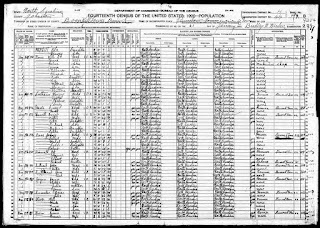

    1920 Census, Boon Hill Lower Precinct, Johnston North Carolina

    In this census, which I covered in detail when I wrote about Fristus and Katie Watkins Howell here, we find the family of six living on a farm outside of Princeton, Johnston NC.  Arlie is six years old.


    1920 -- Historical Insight, Sears, Roebuck and Company

    Credit: Historic Catalogs of Sears, Roebuck and Co.
    1896-1993/Ancestry.com

    1920 -- Historical Insight, Nationalization of 4-H programs


    October 7, 1921, Marlinton, West Virginia. Credit: Library of Congress
    from Ancestry.com Historical Insights

    Youth who participated in 4-H programs learned skills related to farm animals, soil, tools, cookery, and housekeeping. 
    Did Arlie participate in 4-H programs?

    1921, 1924, 1926, 1928 


    Brothers Thadius, Paul Coolidge, Roland and Haywood are born in this decade.  She was aged 8, 10, 12, and 14 years old.  She was just 10 years old when her baby brother Paul Coolidge was either stillborn or died just after birth.  He is buried in Johnston County North Carolina.


    1930 -- residence New Hope, Wayne, North Carollina


    1930 Census, New Hope, Wayne County, North Carolina

    Again, I covered this census in great detail in the blog about Fristus and Katie Watkins Howell, here. Be sure to check it out.  Arlie is 16 years old, here.

    1931, 1933

    1930 ad, Ford Tudor Sedan
    Gasconade County Republican, Owensville MO
    11 September 1930, page 5
    Downloaded 21 March 2017 from Newspapers.com

    Sisters Alline and Eula Evelyn are born when she was aged 17 and 19 years old when these little sisters were born.


    1934 -- untimely death and burial


    Nurse image, source unknown

    No social security death index, it seems she didn't have a social security card.  It was a bit early for that.  She was only 20 years old when she died on a cold February day in Goldsboro, Wayne County North Carolina.  She is buried on the family plot in Johnston County NC.

    1934 death certificate for Arlie Virginia Howell


    • She died at Goldsboro Hospital in Goldsboro NC
    • She lived at 609 Simmons street in Goldsboro
    • Her birth date is 2 October 1913, Johnston County NC, age 20
    • Occupation is worker in the Cotton Mill
    • parents F.H. Howell born NC, Katie Watkins born NC
    • Informant was Miss Louise Watkins who lived in Goldsboro NC.  This would be the Aunt Lou that my dad talked about.  She was Katie's sister, who was married to Ernest Buck.
    • She is buried 2 February 1934 in Princeton, Johnston County, NC
    • the cause of death is acute diffuse purulent peritonitis caused by an abortion.  This means the infection spread throughout the membranes of her abdomen and which then spread to her blood, she went into septic shock, her organs shut down causing death.  Apparently an autopsy was performed.  I cannot decipher the answer to the question "What test confirmed diagnosis?"

    Gravestone for Arlie Virginia Howell
    from FindaGrave
    photo by A.Price


    Later in 1934, there was a major strike at the cotton mill in Gastonia NC.  This is about a four hour drive from Goldsboro, today.  The National Guard got involved, using tear gas.  Here is one of several photos of that event.  Now that I've had a chance to peruse the photographs, there seems to have been several mills involved.  I can't include the photos here, but this is the first page of a search for this subject, check it out!


    Arlie Virginia Howell 1934, 609 Simmons St
    Google Maps view

    Note the proximity of her parents who lived a few blocks away (toward the mid-upper right of the screenshot).  The Cotton Mill, known as Borden Cotton Mill, or Goldsboro Cotton Mill, or Wayne Cotton Mill, was a few block the other direction on Ash street, in the lower right corner of the screenshot.


    Arlie Virginia Howell 1934, 609 Simmons St
    Google Maps Satellite View

    Arial view of the same house


    Arlie Virginia Howell 1934, 609 Simmons St
    Google Maps Street View

    It looks like a cute little house, perhaps abandoned today, by the looks of it.  According to Realtor.com, it is 1800 square feet with 3 beds and 2 baths on a lot less than 8,000 square feet.


    I checked the Goldsboro City Directory for 1934, and I did not find Arlie Virginia Howell.  I searched and found 119 Howells, both related and unrelated, but nothing for Arlie nor Virginia.  So, when I ran a search for the house number, it came up with two hits.  The first one, on page 120, is for Jason W. Herring and his wife Maggie T, a sheet metal worker for Roscoe G. Shipp.  His house is listed as 609 Simmons.  The second one on page 233 at the bottom is for Ruth W. Wilson who is renting the same address.  Hmmm.  the line above is Ruth W. Wilson renting another address on S. Herman.  Am I wrong in assuming that they are renting this place to live in?  Or, since she is renting two places, maybe SHE is the owner and is renting the places out?


    I did find, in the same directory, page 307, that the Goldsboro Hospital was on 307 N. Herman in Goldsboro.  Let's check that address out.  My goodness, that hospital was only a block or three from Arlie's house.


    Goldsboro Hospital 1934
    Google Maps street view, image April 2017


    If you like what you see, be sure to subscribe, and consider supporting me on my patreon page


    Become a Patron!


    Monday, February 5, 2018

    Fristus Howell, Sheriff of Wayne County?

    1930s

    The story as I have heard it from my father, is that his grandfather Fristus Howell was a Sheriff in the 1930s.  While he worked in that capacity, he carried and used this rifle.  This blog is about my attempt to get official corroboration.  It's not that I don't believe my dad, nor other Howell kin, but that there is a lot I don't know, and I am curious about.


    Rifle belonging to Fristus Howell
    photo by Bill, rifle in his possession

    Is the title of Sheriff for the county?  Was his job some other position that carried the convenient title of Sheriff, perhaps a deputy law enforcer?  I ask this, because in the past those women who cared for any invalid was called a nurse even though they had no training in that field.

    Did he go out on raids to knock down moonshine stills?


    What was going on in this area of the country in the 1930s?  Cotton was the primary cash crop for Johnston county, with over 85,000 acres of cotton and only 10,000 acres of tobacco.  However, after the great depression of the 1930s, the cotton cash flow died out.  
    "And today, not a single cotton or textile plant remains in oepration in either Selma nor Smithfield."  In the early 1940s, the economy was such that farmers still used mostly mules to work the land and get the produce to market. -- excerpted from About Johnston County History  
    "... law-enforcement officials [were] in a constant battle with alcohol producers, sellers and consumers [from 1908 to 1933]."  
    "...farmers in the 1920s were suffering under a postwar agricultural depression that brought dramatic fluctuations in cotton and tobacco prices. According to the US Census Bureau, the number of mortgaged farms in the county [nearly doubled in five years]. Cotton farmers tried to make up for their losses by overproducing -- a practice that only served to drive market prices even lower."
    "The stock market crash of 1929 and Great Depression that followed intensified the hard times farmers were already experiencing." With Federal crop controls and the boll weevil infestation, cotton was no longer the king.  Many farmers turned to tobacco growing even though it was not quite profitable. -- from Johnston NC Heritage 


    Moonshine then and now


    Johnston County officials pose with confiscated illegal liquor outside the courthouse in Smithfield in 1951.
    Johnston County officials pose with confiscated illegal liquor 
    outside the courthouse in Smithfield in 1951
    The News & Observer
    According to this article in the NewsObserver website, Johnston County deputies were aided by township constables, and cut down about 10 stills per month.  That would be 2-3 every week.  But the interesting part is the "Township Constables." Could this be the position Fristus held?


    Apparently, moonshinin' is still a thing (see what I did there?)


    mash moonshine
    143 gallons of non-tax paid alcohol
    from JoCoreport.com


    Illegal

    in 2016, a local Johnston County man was arrested for selling illegal moonshine.
    ... reportedly found a large moonshine still, 4402 gallons of mash and 143 gallons of moonshine. The moonshine had an estimated street value of $20 per gallon or a total of $2,860.  from JoCo Report website 

    Legal

    It is now legal for some licensed people to create their own moonshine to sell.  According to Johnston County blog, 
    Distilleries were outlawed in North Carolina in 1909, 11 years before Prohibition went into effect.  After Prohibition ended in 1932, the state permitted breweries and wineries to operate, but continued to ban the manufacturing of spirits. That ban was lifted in 1979. Before Prohibition, North Carolina had more distilleries than any other state.  
    -- Johnston County NC blog
    So, although prohibition ended, moonshine was still illegal, which meant that local law enforcement would recruit men like Fristus Howell to help track down and confiscate the illegal booze.


    Is it legal to make moonshine?

    Moonshine law, legality and home distilling laws vary from state to state and each has its own implications for home distillers.  Obtaining the correct state and federal permits for your distillery is essential before assembling or operating your still.  Unlawful distilling can result in heavy fines and even imprisonment. 
    Due to tax laws, alcohol distribution laws and some statutes left over from Prohibition, distilling without proper permits is illegal under Federal law.  Some states offer small-time distillers, such as those producing spirits for their own consumption, special permits which supersede Federal law.  Other states require Federal permits before offering additional state permits.  Every state requires additional licenses before selling spirits, as there are heavy tax implications and special rules and guidelines for alcohol sales.  While some states will enact penalties simply for owning or a still, other states allow stills to be owned and used for non-alcoholic purposes, such as the production of essential oils.  from HillBilly Stills website


    I have tried to look up a list of past sheriff's in Wayne county, and found an account of the origin of the office of Sheriff, found here.
    An artistic depiction of a historic sheriff on a horse.
    An old illustration of a depiction of an old Sheriff -- the Shire Reeve
    from History of the Sheriff


    Below is one email I received when I inquired about Fristus Howell as Sheriff of either Wayne County or Johnston County in 2005.
    Sent: Thursday, June 23, 2005 4:52 PM
    To: heritagecenter@johnstonnc.com
    Subject: Sheriff
    I was told that my great grandfather was Sheriff in the 1930's.  I think
    it would have been in Johnston County.
    Where should I go to find any record of Fristus Haywood Howell working
    as Sheriff?
    Thank you,
    J'Anette
    You may be able to confirm that your ancestor was a sheriff in Wayne County by calling the office of the Sheriff (919-731-1007).

    From: Wingate Lassiter <mailto:wingate.lassiter@johnstonnc.com>

    Sent: Monday, June 27, 2005 11:08 AM
    Subject: RE: Sheriff
    Checked our various files and came up empty. Couple of sheriffs who did
    serve Johnston County during the 1930s had the last names of Barber and
    Rose. Also, the name of Fristus Haywood Howell did not come up in our
    Smithfield Herald obituary database. Perhaps your great-grandfather
    lived and served in another county.
    Below is the email I just recently rec'd from Johnston County when I again inquired about the office.


    There is not a Howell on our sheriff list, so your great-grandfather was probably a deputy sheriff. I’d be interested in knowing about any stories handed down in your family about still raids, prohibition, etc. We are in the process of putting together a moonshine exhibit to open in mid to late February. Do you know his full name? I checked Fristus Howell in our databases, and absolutely nothing came up.  Best wishes,Todd Johnson

    K. Todd Johnson Executive Director Johnston County Heritage Center PO Box 2709/241 E. Market Street Smithfield, NC 27577919-938-4708 todd.johnson@johnstonnc.com


    What I deduce from this email is that there was prohibition, some moonshine distilling and raids.


    Ncwayne.png
    Johnston and Wayne Counties
    Family Search website


    Map of Wayne County North Carolina with
    Municipal and Township Labels
    Wayne County Wikipedia


    Law office, Goldsboro, April 1938

    Sites of interest from Wikipedia


    • Cliffs of the Neuse State Park is a state park located near the city. It covers 751 acres (3.04 km2) along the southern banks of the Neuse River. It has a swimming area, several hiking trails, fishing areas, a nature museum, and picnic areas. The cliffs rise 90 feet above the Neuse River.
    • Waynesborough Historical Village is a reconstructed "village" located near the original site of the town of Waynesborough. It is home to historical Wayne County buildings ranging from various periods of time. These buildings include a family home, a medical office, a one-room school, a law office, and a Quaker Meeting House.
    • Herman Park includes a recreational center, miniature train, tennis courts, picnic shelters, a turn-of-the-century park house, gazebo, goldfish pond, fountain, and children's playground.
    • The Oheb Shalom synagogue's Romanesque Revival building is one of fewer than a hundred nineteenth-century synagogues still standing in the United States, and the second oldest synagogue building in the state.[16]


    If you like what you see, be sure to subscribe, and consider supporting me on my patreon page


    Become a Patron!


    Resources


    Goldsboro Sites of Interest from Wikipedia  https://en.wikipedia.org/wiki/


    Monday, January 8, 2018

    Back on Track

    Christmas is over, and I am back on track.  I had to take a break in order to catch up on my Christmas knitting. This is an example of what I typically make out of my hand spun and home dyed wool yarn.  You can typically expect a weekly-ish post about the Wonderful Howell Family starting next week-ish.


    Monday, December 4, 2017

    Dorothea Dix Hospital 1960

    There is a lot of information about Dorothea Dix Hospital.  

    It was opened before 1850 and closed about 2000.


    In an 1872 "Bird's Eye View" of Raleigh, the Dix Hill Asylum
    (now Dix Hospital) was labeled simply
    "Lunatic Asylum."
    (Inset illustration in C. Drie,
    "Bird's eye view of the city of Raleigh, North Carolina 1872."
    from Learn NC, link below


    But the most interesting information I gleaned from Katie Howell's death certificate is that she was either
    1. taken to Dix Hill (as it was called) after she'd died at home, where the death was pronounced and the autopsy performed, or
    2. she was already a patient at Dix Hill at the time of death.
    If she died suddenly and was taken to the hospital on an emergency basis, I have no further questions.  Her death was sudden and unavoidable.

    If she was already a patient at the hospital, there are a ton more questions I have.  Why?

    Because Dorothea Dix Hospital was a mental hospital. 

    Dorothea Dix Hospital Female Annex 1900s
    "View of Female Annex, Dorothea Dix Hospital 1900.
    From the General Negative Collection, North Carolina State Archives, Raleigh, NC."
    from Flickr, State Archives of North Carolina


    According to the Learn NC website,
    "Traditionally, the mentally ill who could not be kept with their families became the responsibility of local government, and were often kept in common jails or poorhouses where they received no special care or medical treatment. Reformers sought to create places of refuge for the insane where they could be cared for and treated. By the late 1840s, all but two of the original thirteen states had created hospitals for the mentally ill, or had made provision to care for them in existing state hospitals. Only North Carolina and Delaware had done nothing."

    "[In] 1856 that the facility was ready to admit its first patients. Dorothea Dix refused to allow the hospital to be named after herself, although she did permit the site on which it was built to be called Dix Hill in honor of her father. One hundred years after the first patient was admitted, the General Assembly voted to change the name of Dix Hill Asylum to Dorothea Dix Hospital."


    Cherry Ames Rural Nurse 
    On the wordpress site NC Archives, we find this information:
     
    Dorothea Dix Hospital, formerly known as the The State Hospital at Raleigh, was named for Dorothea Dix (1802-1887), an activist who worked for improving conditions for the mentally ill in hospitals and asylums. Dix influenced North Carolina legislators to remove mentally ill inmates from prisons and to create a state institution where they could receive treatment. A location was chosen in the countryside a short distance outside of Raleigh, North Carolina . The first patient was admitted on February 22, 1856, and, fifty-one males and thirty-nine females were admitted during the next nine months. During the early twentieth century the hospital continued to add more buildings to the facility in addition to new patients. By the 1930’s there were over 2,000 patients. Situated on a 425 acre tract of land on the south side of the city of Raleigh, there are more than 120 separate buildings on the site, many of which were constructed during 1910-1930 and 1960-1980. The buildings are used for patient care, offices, shops, warehouses and other activities in support of the hospital. The photographs in this collection include images of the hospital’s buildings, facilities, staff, and residents. (1 box, ca. 3 linear feet.) 
    This website includes some links that are broken, unfortunately.


    From the Science Museum in UK, we find this explaination of women's mental issues in the 1950s and 1960s:

    Feminism and Change:  Many women’s lives in the 1960s and 1970s were still organised around Victorian stereotypes of the loving mother and dutiful housewife. Women who did not behave ‘properly’ risked ending up in psychiatric care. ... Freud’s focus on sexual fantasies, and the fact that most of his patients were women, rehashed old ideas. It was similar to hysteria being labelled a ‘women’s problem’ that should be cured by finding a man.

    Nurses and Mental patient
    Patients discharged from the State Hospital in Raleigh suffered from the stigma associated with mental institutions, and having been a patient of that hospital.  In 1959 the name of the hospital was changed to the Dorothea Dix Hospital to honor Dorothea Lynde Dix.  It is incredible that legislators assumed that changing the name of the hospital would change people's perception of mental illness.
    In the 1960s and 1970s North Carolina used federal funds to open a number of community mental health clinics to relieve the overcrowded state psychiatric hospitals. . As a result of these trends, a reevaluation and downsizing of the state mental health programs was undertaken. The populations of the four state psychiatric hospitals decreased from approximately 10,000 in 1964 to 2,700 by 1989. As patient populations continued to shrink at state hospitals, physicians began to offer more sophisticated treatments. Dorothea Dix Hospital, once the cornerstone of psychiatric care in the state, was scheduled to be closed in 2007. -- https://www.ncpedia.org/psychiatric-hospitals

    The Questions

    If Katie was in the mental hospital, it could be for a couple of reasons.  She could have genuine mental problems.  or she could have been sent there for some spurious reason.

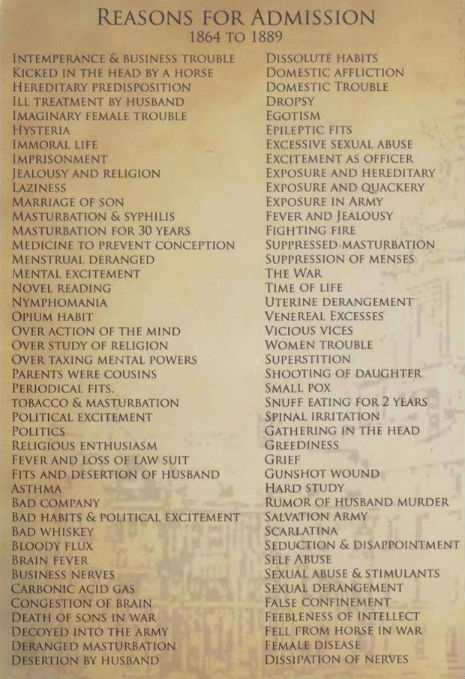
    Some reasons for admission to mental hospital include:

    List of reasons for admission to an insane asylum
    from the late 1800s
    from dangerousminds.net

    While this list is applicable for 1860s, I cannot find a list of reasons for a woman, a grandmother, to be admitted in the 1960s.  Author Wendy Wallace published an article about women's mental health.  She included an anecdote about her grandmother who, in the late 1960s, fell into serious depression after the sudden death of her husband.  She was too lonely and found it impossible to cope.  This is the ONLY story I found of this decade, and it makes me wonder if Katie was depressed?  Assuming, of course, that she was already a patient of the hospital at the time of her death.
    In the late 1960s, my gentle grandmother was plunged into a serious depression after the sudden death of her husband from a heart attack. A daring and sporty young woman, who grew up in a lively family, she found the loneliness and grief of widowhood in her 50s unbearable.
    1954 dresses, The News Herald, 10 December 1954, Newspapers.com
    I was 11 or 12 when she became ill; the stigma around mental distress was stronger than it is now and my parents tried to protect me from it. But I noticed how Gran’s round shape changed to a drastically reduced outline and was aware of my parents’ worried conversations about her, of emergency phone calls and sudden dashes to see her in hospital, where, I later found out, she was admitted more than once after attempts on her own life.

    My grandmother’s grief might today be recognised as such, and treated with bereavement counselling rather than being labelled ‘depression’, as it was in the 60s, and treated with electroconvulsive therapy (ECT). However horrific the idea of ECT seems to my generation, which associates it with the shocking scenes in the film One Flew Over the Cuckoo’s Nest, how much worse, I wondered, would her situation have been 100 years earlier. Anyone who could persuade two doctors to sign certificates of insanity could put away inconvenient or embarrassing relatives in a madhouse. Women – with lower social status, and usually less power and money – were more vulnerable. -- By Wendy Wallace

    An Answer

    I have contacted family members to find out.  I essentially crowd-sourced my question on FaceBook, knowing several Howell kin were my friends, or were my Dad's friends.  I wrote,
    I am a genealogist/Family Historian. I'm looking for information regarding the death of Katie Watkins Howell, wife of Fristus Howell, North Carolina. If you have any information, reply here or in a private message. Thank you. Feel free to pass this request along to any family member who might be able to help.
    Dad replied that Great Gramma died just after he and my mother married, and is buried in the same Howell Family cemetery that her husband Fristus Howell and my grandmother Lois Howell Vidunas are buried.

    A cousin added "She had an aneurysm. Died at Dorethea Dix hospital from what I’ve been told."  Dad didn't know this information.

    I then asked if she'd been taken to the hospital or was she already there at the time of her death.  Cousin replied that she'd had an aneurysm and died at Dorothea Dix Hospital, had been staying at the hospital at the time of her death, and that she had had some mental problems in her later years.  
    The Skirmisher, History of the United States by Ellis 1894

    Dad mentioned that his grandmother had problems remembering things, of knowing what was going on around her.  I'm not sure what kind of mental problems she actually had, but I do know that her family was a loving family and they cared for her the best way they possibly could.  The doctors did not know very much about mental illness, what caused it, how it should be treated.  Even the definition of mental illness was debatable by today's standards.  I'm sure, if she were alive today, her treatment would look entirely different due to the research scientists did in recent years.  Mental illness is just as debilitating as physical illness is.  It can sap the vitality right out of you, and it takes a great deal of energy to get out of that great abyss.  Sufferers need lots of help.  From us all.

    Credits

    • Learn NC website
      • http://www.learnnc.org/lp/editions/nchist-newnation/4780
    • Science Museum
      • http://broughttolife.sciencemuseum.org.uk/broughttolife/themes/menalhealthandillness/womanandpsychiatry
    • dangerousminds.net
      • http://dangerousminds.net/comments/list_of_reasons_for_admission_to_an_insane_asylum
    • State Archives of North Carolina, Flickr
      • https://www.flickr.com/photos/north-carolina-state-archives/6238475302/
    • Wendy Wallace Article "Sent to the asylum: The Victorian women locked up because they were suffering from stress, post natal depression and anxiety"
      • http://www.dailymail.co.uk/home/you/article-2141741/Sent-asylum-The-Victorian-women-locked-suffering-stress-post-natal-depression-anxiety.html 

    Resources of interest
    https://www.flickr.com/photos/north-carolina-state-archives/page5


    Garland Arthur Howell Part 6

    Garland Arthur Howell Part 6 1960 -- Mother Katie Elizabeth Watkins Howell died 1961 -- Historical Insight -- John F. Kennedy Inaugura...