1920 -- Sister Annie Lois is born 1920 -- Census Boone Hill, Johnston County NC 1920 -- Historical Insights -- Sears, Roebuck and Company; Nationalization of 4-H Program 1921 -- Brother Melvin Thadius is born 1924 -- Brother Paul Coolidge is born, died age 4 months 1926 -- Brother William Roland Howell is born
1920, age 5
The fifth child, sister Annie Lois Howell was born in Princeton RFD, Micro Township, Johnston County NC. She went by Lois, died in 1973. She is my grandmother.
1920, age 6
According to the Federal Census, he is living with his family in Boon Hill, Johnston County NC. Now, did they move back to Boon Hill? Did boundaries change even though they stayed on the farm? I haven't researched this yet. If you have any idea, be sure to let me know, using the communication form on the right.
1920 Census, Boon Hill, Johnston County NC
Historical Insight -- Sears, Roebuck and Company
Garland Arthur Howell most likely read or shopped from the Sears catalog.
1914-1930 Sears, Roebuck and Company
Ancestry.com's Historical Insight
"In 1918, the Sears catalog sold the plans and materials for homes like
Model No. 2094, 'The Verona,' for $4096. A number of these existing homes
have been added to the National Register of Historic Places.
1918 Credit: Sears Roebuck & Co./Wikimedia Commons/Public Domain
Historical Insight -- Nationalization of 4-H Programs
Garland may have participated in a 4-H program while a youth in North Carolina. "Utah's Logan Republican reported in September 1914 that 200,000 youth around the country were participating in 'Industrial Clubs.'"
1930 The Nationalization of 4-H Programs
13 October 1921, Charleston, West Virginia.
Credit: Library of Congress
from Ancestry.com Historical Insight
1921, age 6
Birth of brother Melvin Thadius Howell was born 27 October in Johnston County NC. He went by Thad, died in 2009.
1924, age 9
Birth of brother Paul Coolidge 7 January 1924 in Johnston County NC. He died about 4 months later of IleoColitis lasting 8 days. This may be Crohn's disease, according to Medicine Net.
1926, age 11
Birth of brother William Roland Howell on 13 March in Wayne County NC. He went by Roland, and died in 2009.
Bissell Mills Road, New Hope, Wayne North Carolina. Starting at line 42, his name looks like Forst or First H. Howell
Forst H. Howell, Head, Renting, living on a farm, as did most everybody around them. white male age 57, married, first married at age 30. Unable to read and write, he and parents all born in NC.
Katie E. Howell, Wife, Homemaker. white female age 33, married first at age 17. did not attend school, is able to read and write. She and parents all born in NC.
Arlie V. Howell, daughter; age 16, single female, did not attend school, can read and write, born NC.
Garland A. Howell, son; age 15, single, attended school, is able to read and write, born NC.
Pauline M. Howell, daughter; age 13, single, attended school, is able to read and write, born NC.
Letha B. Howell, daughter; age 11, attended school, is able to read and write. born NC.
Annie L. Howell, daughter; age 10, attended school, is able to read and write, born NC.
Melvin T. Howell, son; age 8, attends school, born NC.
William R. Howell, son; age 4 1/12, did not attend school, born NC.
I found something weird when I used Google Maps to search for this place. This screenshot is of New Hope NC. It is in the upper left corner of this view where the location marker is. Goldsboro is in the lower right portion of this view. This is quite a ways away from what I thought was his normal stomping grounds.
New Hope NC
from Google Maps 2017
and yet, when we look closer, there is no Bissel Road, it just doesn't look right. Let's try something else.
New Hope NC closer view
from Google Maps 2017
Well, I searched for "Bissell Road" in NC and got no results. I'm lost. Did they actually live that far from Goldsboro?
Prior to 1730, Native Americans were the only known occupants of the territory now known as Wayne county. Settlers trickled into the territory, but there was no general movement of immigration until after 1750. Wayne County was established on November 2, 1779 from the western part of Dobbs County. It was named for "Mad Anthony" Wayne, a general in the American Revolutionary War. The act, establishing the County, provided the first court should be held at the home of Josiah Sasser at which time the justices were to decide on a place for all subsequent courts until a courthouse could be erected. By 1782 the commissioners were named. In 1787 an act was passed establishing Waynesborough on the west side of the Neuse River on the land of Doctor Andrew Bass where the courthouse now stands.[3] -- https://en.wikipedia.org/wiki/Wayne_County,_North_Carolina
I may have found what I need!
Map of Wayne County, North Carolina, United States with township and municipal boundaries
Take a look at the right side, two-thirds down. The area is marked as "New Hope" and it is pretty close to Goldsboro. This is also within Wayne County, and fits the parameters. Now, I will search this area on Google Maps.
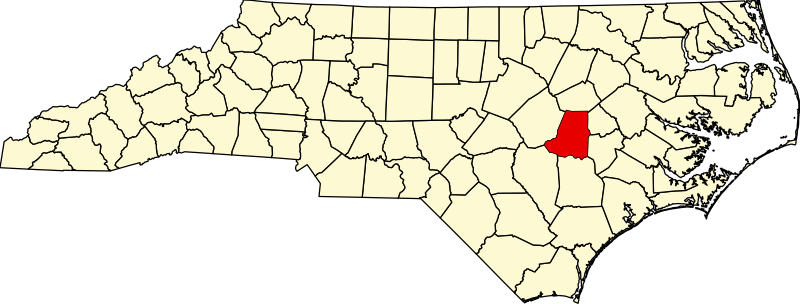
This is a locator map showing Wayne County in North Carolina https://en.wikipedia.org/wiki/File:Map_of_North_Carolina_highlighting_Wayne_County.svg
This is a locator map showing Johnston County in North Carolina https://en.wikipedia.org/wiki/File:Map_of_North_Carolina_highlighting_Johnston_County.svg
YEP! I do believe I found what I was looking for.
New Hope NC Map View
from Google Maps 2017
See where Goldsboro is in the upper left. Walnut Creek is in the lower right. Above that is the area listed as New Hope. In Walnut Creek, I found a road marked as "Mills Road," but no Bissell Mills Road. Let's explore further.
I looked closer on the map, found a Mills pond, and New Hope road, but nothing I was searching for. Of course, things change, but shouldn't be too much, right? We are looking for farming land. I'll try the property search next, perhaps.
Fristus Haywood Howell's Shotgun
used in the 1930s
owned by grandson William Vidunas
1931, age 58
clip art baby-green AntiqueClipArt
Birth of daughter Ida Alline Howell, 3 February 1931, Wayne County NC
1933, age 60
Birth of daughter Eula Evelyn Howell, 2 May 1933, Wayne County NC
End of Prohibition
1934, age 61
death of daughter Arlie Virginia Howell, 1 February 1934, Goldsboro, Wayne NC
Birth of daughter Julia Elizabeth Howell, 13 July 1934, Goldsboro, Wayne NC
Death of daughter Julia Elizabeth Howell, 31 August 1934, Goldsboro, Wayne County NC
Lived in Goldsboro NC
1935, age 63
lived in Goldsboro NC
1936, age 64
Death of sister Nellie G. Howell, 6 December 1936, Goldsboro, Wayne NC
Federal alcohol prohibition was repealed in December 1933, but many Americans had been ignoring the law for years.
Credit: American Stock Archive/Archive Photos/Getty Images
from Ancestry.com
In a 1939 news column, Eleanor Roosevelt looked back at the prohibition era and concluded that “a moral change still depends on the individual and not on the passage of any law.” The idea that the state cannot legislate morality was a clear lesson from the federal government’s nearly 14-year attempt to prohibit the production and sale of alcohol. Ratification of the 18th Amendment in 1919 led to a lucrative black market for organized crime, corruption within police departments, and a general lack of respect for the law by a broad cross section of the American public. Many people celebrated on December 5, 1933, when ratification of the 21st Amendment repealed prohibition. The editors of the Milwaukee Journal wrote: “Prohibition is gone. Few will mourn its passing. It never was a real success, for it never really shut off the supply of alcoholic beverages to those who sought them.”
Media Gallery
The 21st Amendment left alcohol prohibition for the states to decide, and Mississippi remained a “dry” state until 1966. December 5, 1933, New York, New York. Credit: Imagno/Hulton Archive/Getty Images
For many Californians, the end of federal alcohol prohibition meant the return of the traditional wine festival. 1934, California. Credit: Underwood Archives/Archive Photos/Getty Images
In the post-prohibition era, taverns were promoted as places for families and mixed crowds of men and women. September 1938, Raceland, Louisiana. Credit: Russell Lee/Wikimedia Commons/Public Domain
With breweries and distilleries back in business, the government regained a source of tax revenue during the Great Depression. 1934, New York, New York. Credit: Keystone/Hulton Archive/Getty Images
Fristus and Katie Elizabeth Watkins Howell
1920 NC Census
1920 Census, Boon Hill, Lower Precinct, Johnston County North Carolina. Dated 21 January 1920
Start at Line 70. Farm, owned free and clear.
Frrist (sic) Howell, Head, white male, age 46, married. Unable to read nor write. He was born in North Carolina as were both his parents. Speaks English, is a Farmer on his own General Farm.
Kattie Howell, wife, white female, age 24, married. able to read and write, born in NC, both parents born NC. Able to speak English, not employed.
Artie Howell, daughter, white female age 6, single. born NC. Able to speak English, not employed.
Garland Howell, son, white male age 4. born NC.
Pauline Howell, daughter, age 3. born NC.
Letha Howell, daughter, age 1. born NC.
Screenshot of Boon Hill NC. The lower precinct would be south of the highway, borders the Neuse River.
Boon Hill NC
from google Maps 2017
This is an 1896 newspaper article describing how the township was divided for voting purposes.
Upper_and_Lower_Boon_Hill_precincts_1896 (1)
from Newspapers.com
1920, age 47
Birth of daughter Annie Lois Howell, 26 February 1920, Princeton RFD, Micro Twp, Johnston County NC
This is a photo of Fristus and Katie Howell, with their son and granddaughter Henry Howell and Wilma Gray Howell in Gastonia NC. Wilma was in hospital for a long time, I think with an injured leg.
Update -- My dad tells me Wilma Gray had one leg longer than the other, and the surgery was to "balance things out." Her brother Joe had the same condition. Sounds like it is genetic?
Fristus and Katie Howell with
Henry Howell and Wilma Gray Howell
Gastonia NC, photo from Amanda Price
1921, age 49
Birth of son Melvin Thadius Howell, 27 October 1921, Johnston NC
1924, age 51
Birth of son Paul Coolidge Howell, 7 January 1924, Boon Hill, Johnston, NC
Death of sister Mary Catherine Howell, 28 April 1924, Johnston County NC
Death of son Paul Coolidge Howell, 27 May 1924, Boon Hill, Johnston NC
1926, age 53
Birth of son William Roland Howell, 13 March 1926, Wayne County NC
1928, age 58
Birth of son Henry Haywood Jethro Howell, 18 May 1928, Wayne NC
Fristus Howell 3 gen pedigree
from Ancestry.com
1929 Historical Insight -- The Great Depression
The Stock Market Crash of 1929 propelled the United States into the worst hard times: the Great Depression
Credit: MPI/Archive Photos/Getty Images
from Ancestry.com
October 24, 1929, was one of the darkest days in American history. On Black Tuesday, the hopeful, prosperity of the Roaring Twenties came to an abrupt end when the stock market crashed. Suddenly, the United States, and the world with it, was propelled into the Great Depression. Americans began withdrawing their money from banks, causing them to fail. Industrial production came to a standstill and unemployment skyrocketed. Unable to pay their bills, hundreds of thousands of Americans became homeless. By 1933, 15 million were without work and almost half of all U.S. banks had shuttered. To make matters worse, a historic drought caused widespread farmland erosion across the Prairie, precipitating the Dust Bowl. The “only thing we have to fear is fear itself” declared incoming President Franklin D. Roosevelt during his 1933 inauguration. Immediately he set to work rebuilding the country. Through a series of federal programs, he launched the New Deal, which revived banks, created millions of jobs, and helped Americans from going hungry. Slowly, the economy picked up, and with the outbreak of World War II in 1939, factories across the United States kicked into high gear, propelling the country out of the worst economic depression in its history.
Media Gallery
Hundreds of thousands of Americans relied on soup kitchens and charity for meals during the Great Depression. February 1931, Chicago, Illinois. Credit: Wikimedia Commons/Public Domain
Dust storms wreaked havoc on farms across the American heartland, caused the closure of entire towns, and prompted hundreds of thousands to flee their homes for greener pastures along the West Coast. Many became migrant farmers in California. April 1936, Cimarron County, Oklahoma. Credit: Arthur Rothstein/Wikimedia Commons/Public Domain
Because so many Americans were unable to pay their bills, evictions became widespread. Many built makeshift homes, dubbed “Hoovervilles” because of the outgoing president’s inability to combat the growing poverty. Condemned as unsightly, some like this shantytown in the nation’s capital, were burned to the ground. 1932, Washington, D.C.. Credit: Signal Corps photographer/Wikimedia Commons/Public Domain
Though the vast majority of the jobs created by President Roosevelt during the Great Depression were for unskilled laborers, he also employed artists to document life across the country. This photograph of a migrant family escaping the Dust Bowl was shot by Dorothea Lange and has become an iconic work from the era. 1936, Nipomo, California. Credit: Dorothea Lange/Wikimedia Commons/Public Domain